Bucharest blends belle-époque elegance with communist-era monumentalism, leafy parks and a fast-rising food and coffee scene — a cityscape unlike any other European capital, and far cheaper than most. Whether you are drawn to grand landmarks, quiet green spaces or living culture, the city rewards a few unhurried days. Below are the attractions worth building a trip around, each with what to expect and the practical details — prices, timing, how to get there — so you can plan with confidence.
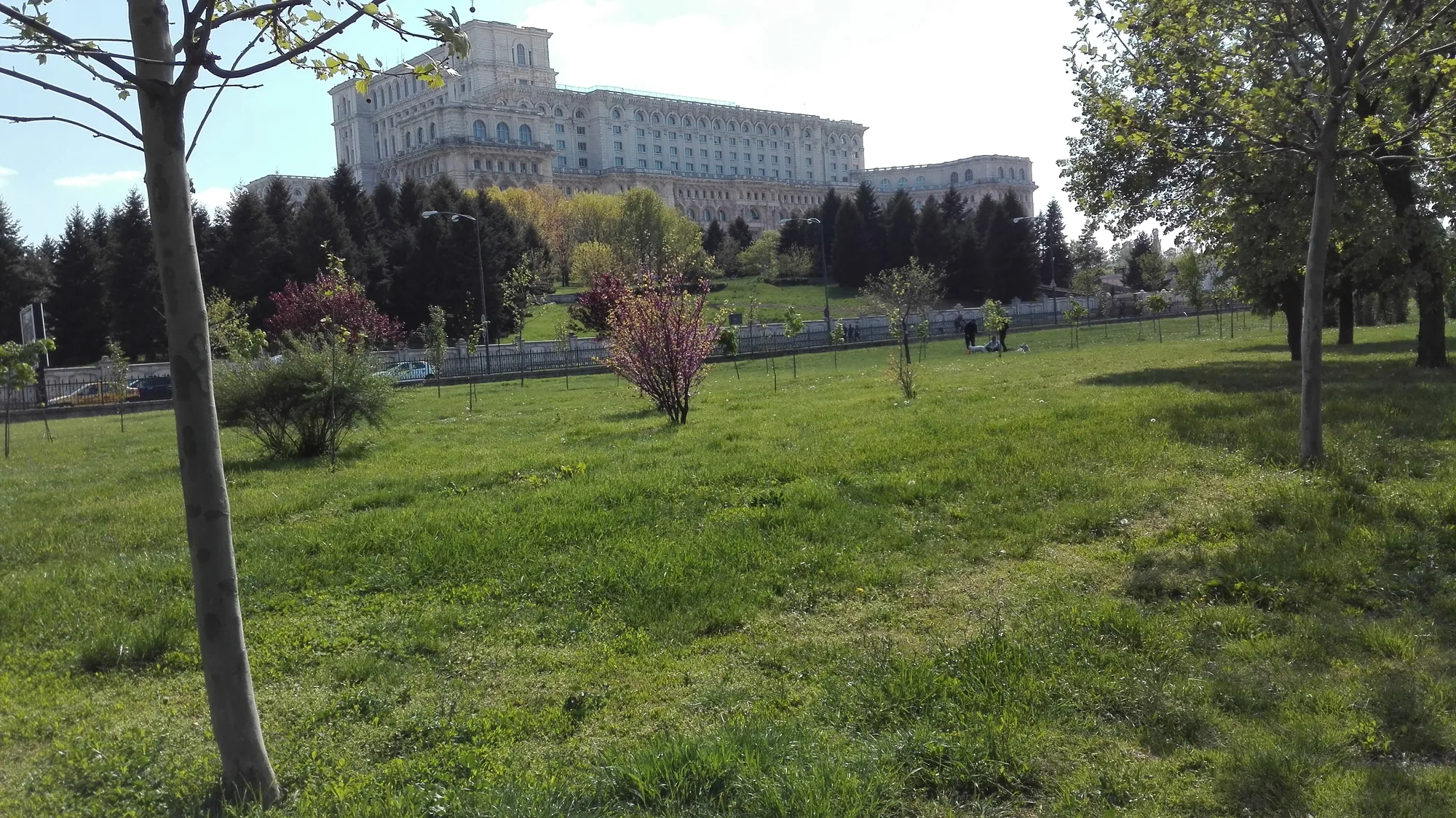
The colossal "People's House" (Casa Poporului) is the building Bucharest is known for — among the largest administrative buildings on earth, with over a thousand rooms raised in the final, ruinous years of the communist era. To clear the ground, Ceaușescu's regime demolished a vast slice of the old Uranus quarter, displacing tens of thousands of residents and several churches; the marble, crystal and hardwood inside were almost all sourced from within Romania. You can only go in on a guided tour, and the sheer scale — endless marble corridors, ballroom-sized chambers, a 3,000-square-metre carpet woven on site, and a balcony that has hosted Michael Jackson — is exactly the point. Today the building houses the Romanian Parliament, an international conference centre and the contemporary-art museum MNAC, and the guided route only ever covers a fraction of the floor space.
Good to know
Standard guided tour around 60 lei adult (reduced rates for students and children; under-7s free); a photography permit and the extended underground/terrace routes cost more. Book ahead through the official site, especially on weekends, and arrive with your passport or ID for the airport-style security. Allow 2–3 hours including the queue and arrival buffer.
Highlights
✦Guided tours only
✦Monumental interior halls
✦Terrace route for views
✦Photo ID required at security
A walkable tangle of 19th-century streets that is the city's social heart — cafés and terraces by day, one of Eastern Europe's liveliest nightlife quarters by night. The name Lipscani comes from the merchants who once traded goods from Leipzig here, and the surviving street names still echo the old guilds. Beyond the bars it hides genuine treasures: the tiny Stavropoleos Monastery, a 1724 jewel of carved-stone Brâncovenesc craftsmanship; the glass-roofed Pasajul Macca-Vilacrosse, a yellow-lit covered arcade; the galleried courtyard of Hanul lui Manuc, an early-1800s caravanserai inn; and the white spiral galleries of the Cărturești Carusel bookshop. It is free to wander and the best place in the city to simply get pleasantly lost between a coffee and a glass of Romanian wine.
Good to know
Free to explore; most central sights are a short walk apart, and the core is pedestrianised. Step a street or two back from the busiest, tout-heavy lanes for far better-value food and drink, and always check prices before ordering on the main terraces.
Highlights
✦Stavropoleos Monastery
✦Pasajul Macca-Vilacrosse
✦Hanul lui Manuc
✦Cărturești Carusel bookshop
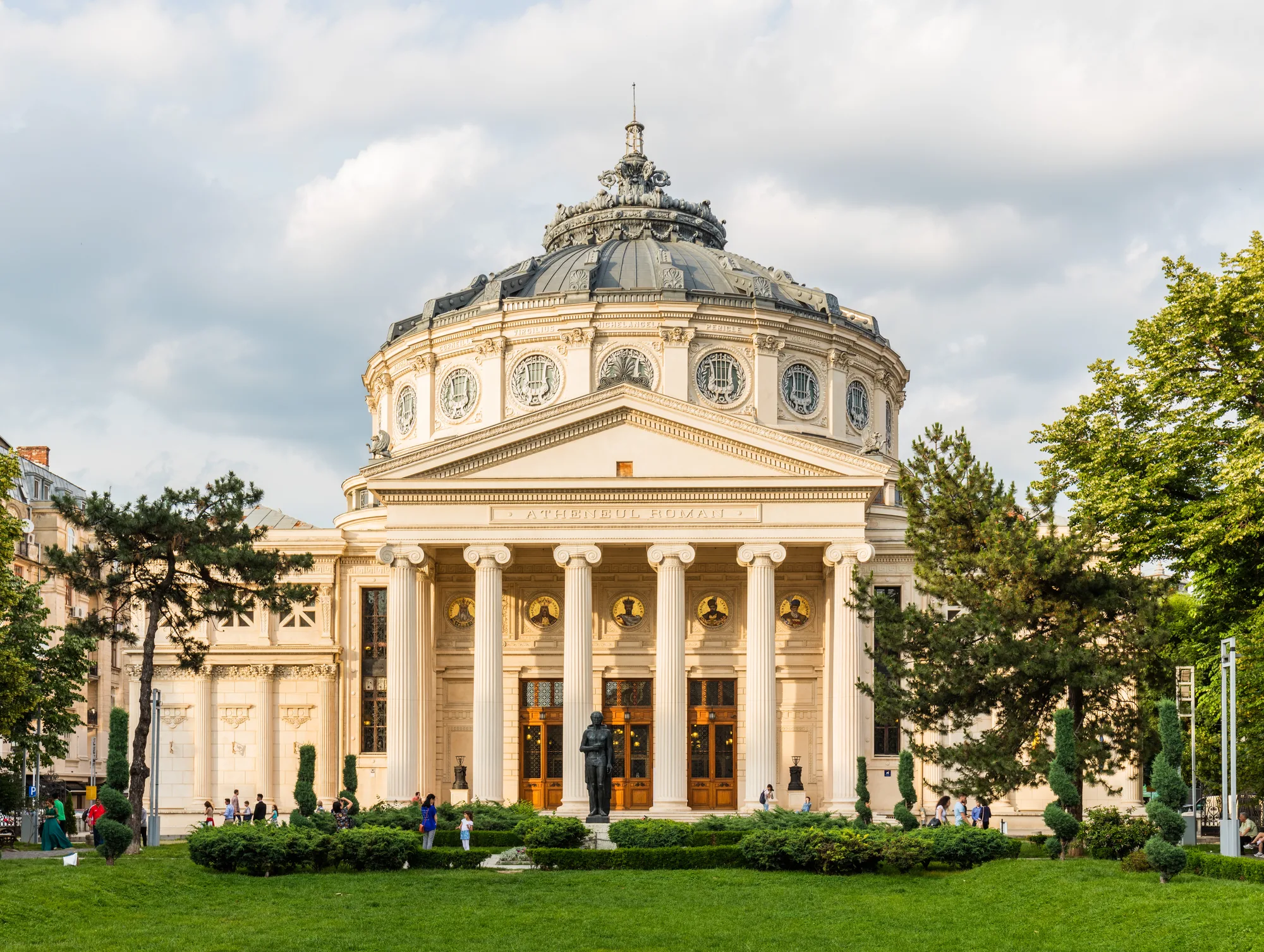
Bucharest's most beautiful building and the home of the George Enescu Philharmonic — a domed, neoclassical concert hall opened in 1888 and partly funded by a famous public subscription whose slogan, "Dați un leu pentru Ateneu" ("Give a leu for the Athenaeum"), still defines the city's civic pride. The circular auditorium is wrapped in a sweeping 75-metre fresco tracing Romanian history from Roman Dacia to the modern kingdom, and the acoustics are superb. You can pop in for a short self-guided visit by day, but the real magic is hearing a concert under that painted dome; it is the principal stage of the George Enescu Festival (odd years) and Competition (even years). It anchors the elegant little square just off Calea Victoriei, beside Revolution Square.
Good to know
Self-guided visit around 15 lei (cash, bought at the box office); daytime access depends entirely on the rehearsal and concert schedule, so it is not guaranteed. A concert ticket — remarkably cheap by Western-European standards — is the far better experience if your timing allows. Guided tours must be arranged in advance by email with the Philharmonic.
Highlights
✦Neoclassical concert hall
✦Sweeping interior fresco
✦Live philharmonic performances
✦Short self-guided visits
An open-air museum on the shore of Herăstrău Park, founded in 1936, gathering more than 300 authentic rural homes, wooden churches, watermills and farmsteads relocated piece by piece from every region of Romania and reassembled across a lakeside parkland. Wandering between the steep-roofed Maramureș houses, the painted Oltenia cottages and the half-buried Danube-delta reed dwellings is the easiest way to understand the country beyond the capital in a single afternoon — effectively a walk across Romania's rural architecture. Craft demonstrations and seasonal fairs add life on weekends, and it is genuinely family-friendly, with plenty of space for children to roam between the buildings.
Good to know
Adult ticket around 10 lei (under-7s free; reduced rates for students and seniors); open broadly daily ~09:00–19:00 with shorter winter hours, and Mon–Tue is a reduced-price, outdoor-only visit with the indoor exhibition halls closed. Metro M2 to Aviatorilor, then a short walk down Kiseleff, or a bus along the boulevard.
Highlights
✦300+ traditional buildings
✦Wooden churches
✦Rural crafts
✦In King Mihai I Park
The city's great green lung — a large lakeside park in the north, the biggest in Bucharest, with walking and cycling paths circling the water, boat and pedalo rentals, a tranquil Japanese garden, an island, and a string of waterfront restaurants and summer terraces. Officially renamed King Mihai I Park, it is where Bucharest comes to relax, run, picnic and date, and it is entirely free to enjoy. Circle the roughly five-kilometre lakeside loop, hire a boat on a warm afternoon, or simply claim a bench under the trees; after a heavy morning of marble and monuments it is the perfect antidote, and it sits right beside the Village Museum for an easy combined half-day.
Good to know
Free; open all day, every day. Boat rentals, bike hire and the café terraces are seasonal (spring to autumn). Combine it with the adjacent Village Museum for an easy, low-cost half-day in the green north of the city.
Highlights
✦Lakeside paths
✦Boat rentals (summer)
✦Japanese garden
✦Waterfront dining
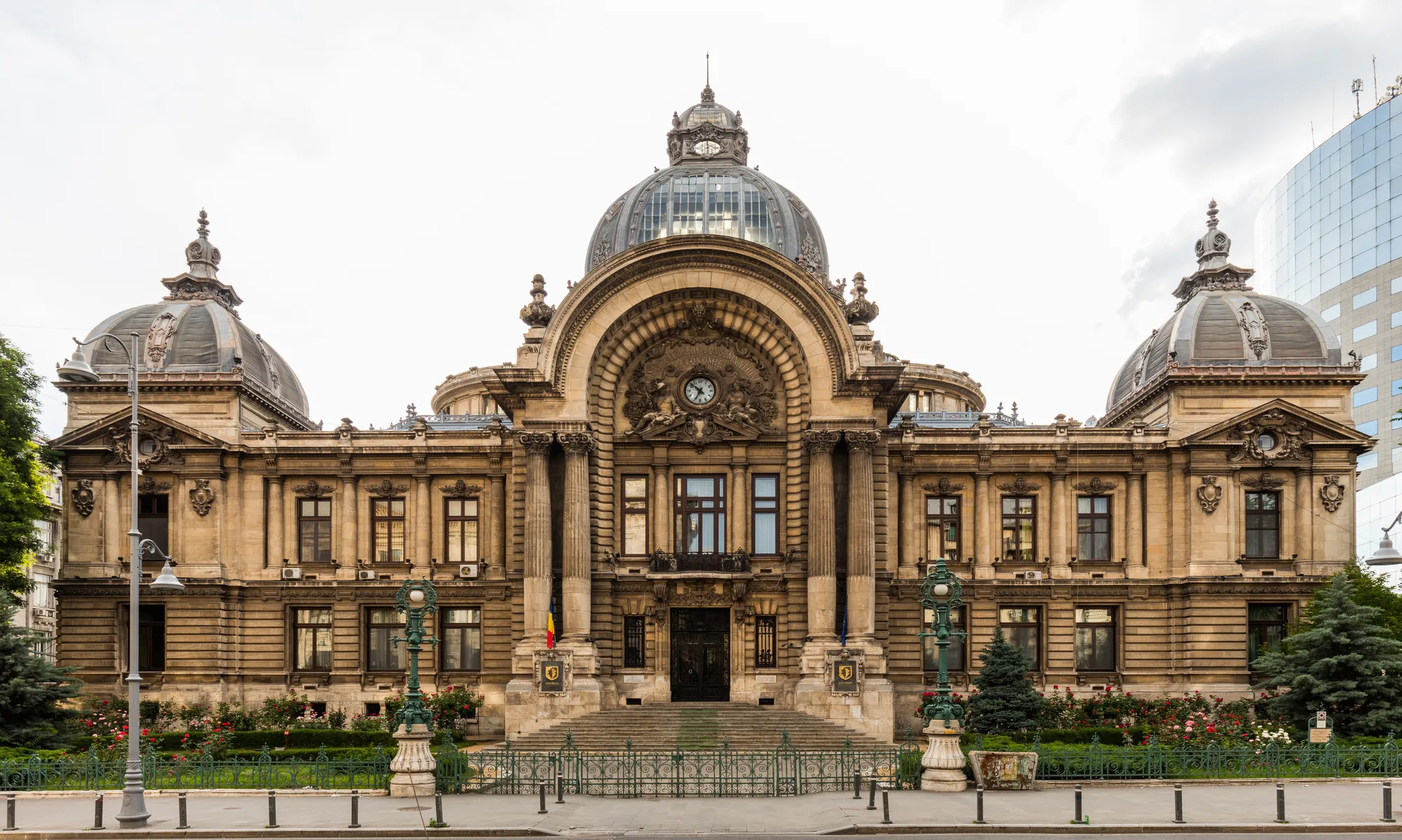
Bucharest's grand boulevard, running roughly 2.7 km from Piața Victoriei down to the Dâmbovița river, and the single best free walk in the city. Laid in the 17th century and once paved with oak logs, it strings together an extraordinary run of landmarks — the Romanian Athenaeum, the National Museum of Art in the former Royal Palace, Revolution Square with its memorial to 1989, the glorious domed CEC Palace, the Casa Capșa café-institution, and a parade of belle-époque, art-deco and communist-era facades, terraces and shops. Walking its length is itself a tour of the city's layered history, and it is loveliest at dusk when the buildings light up; on summer weekends the central stretch is pedestrianised for strollers, cyclists and street performers.
Good to know
Free to walk; the museums along it charge admission. Best in the late afternoon and early evening for the light and the atmosphere. Check whether your visit falls on a summer weekend, when the boulevard goes car-free and the mood is at its best.
The oldest public garden in the city, laid out from the 1840s by the German landscape architect Carl Meyer, and a romantic central retreat of winding paths, a serpentine lake, Victorian-style lampposts, a "Rondul Roman" of busts of Romanian writers, and shaded benches a short walk from both the Old Town and Calea Victoriei. It is smaller and more intimate than Herăstrău and perfect for a midday breather between sights — locals come to play chess, read on a bench or row across the lake. Rowboats appear on the water in summer and the central pavilion serves drinks; in winter part of the lake sometimes turns into an ice rink.
Good to know
Free; open all day, wonderfully central and easy to reach on foot from the main sights. Boat rentals are seasonal and budget-friendly. A perfect, no-cost pause to break up a museum-heavy day.
Highlights
✦Oldest public garden
✦Lake with rowboats (summer)
✦Romantic shaded paths
✦Central location
On the city's northern edge near the airport, Therme is one of Europe's largest thermal-wellness and botanical complexes — drawing on geothermal water, it spreads mineral pools, palm-filled relaxation zones, saunas, water slides and adults-only spaces under huge glass domes, alongside thousands of real palms and tropical plants. It is a full-day escape rather than a quick stop, organised into zones (the family-friendly Galaxy with the slides, the calmer palm-fringed Palm, and the adults-only Elysium spa world), and it makes a brilliant rainy-day, hangover or cold-weather plan. Pricing is zone- and time-based and changes often, so check the day you go.
Good to know
Zone- and time-based pricing that is seasonally tiered (the Galaxy zone roughly 70–110 lei, The Palm roughly 100–200 lei by duration, Elysium higher); weekday-evening specials are cheaper. Long daily hours, broadly ~10:00 to late, with extended Friday–Saturday nights. It is ~10–15 km north of the centre, so plan a shuttle, taxi or rideshare and bring a towel and flip-flops (or hire them there).
The historic core is compact and genuinely walkable — the Old Town, Calea Victoriei, Cișmigiu and Revolution Square are all within an easy stroll of each other, and walking is the best way to take in the architecture. For the longer hops to the green north (Herăstrău, the Village Museum) or out to Therme, the city has cheap, frequent transport.
The metro is fast, clean and inexpensive — around 7 lei a ride on a rechargeable card (the fare rose from ~5 lei on 1 May 2026, so check the live price), running roughly 05:00–23:00. Line M2 (the north–south line) is the most useful for visitors, linking Piața Unirii, Universitate, Piața Romană, Piața Victoriei and Aviatorilor. Surface trams, trolleybuses and buses run on a separate STB card. After the metro closes, ride-hailing apps (Bolt, Uber) are cheap, reliable and the easiest late-night option — always use an app-ordered car rather than a street tout.
Late spring (May–June) and early autumn (September–October) are the sweet spots: warm but not fierce, with the parks at their greenest, the summer terraces and boat rentals open, and the light at its best along Calea Victoriei. September in odd years also brings the headline George Enescu Festival, with world-class concerts filling the Athenaeum and Sala Palatului.
High summer (July–August) is hot — sometimes well into the 30s°C — but the city empties of locals, terraces and grădină (garden) bars thrive, and Therme makes a cooling escape. Winter is cold and grey, yet it has its own charms: the Christmas markets around Piața Constituției and the Old Town, fewer crowds at the museums, and Therme as a steamy refuge. Whenever you come, keep one indoor backup (a museum or the spa) in your pocket for a wet day.
Discover more curated guides to help you make the most of your time in Romania's vibrant capital