Bucharest Old Town is compact, but the experience changes dramatically with timing. Start in the morning for quiet streets and detail-hunting, then return at night for lights and atmosphere.
The Old Town — Centrul Vechi, built around Lipscani Street — is the oldest and densest pocket of Bucharest, and it packs an enormous amount of history into a few hundred metres. This is where the city literally started: the Old Princely Court (Curtea Veche) is the residence linked to Vlad the Impaler, and the document that first names Bucharest dates to 1459. Layered on top of that medieval core are the merchant inns, the guild streets, an 18th-century monastery, a belle-époque glass passage and a famous bookshop in a restored bank — all within an easy loop.
The route below runs roughly 2 km and visits eight stops in a sensible order, starting at University Square and looping through the lanes before finishing in the dinner-and-bars zone. Each stop lists an approximate distance and how long to linger, so you can flex it from a brisk 90-minute version to a slow half-day. It is fully self-guided — follow it on a phone map and take your time.
0 km · the entry point
University Square is the easiest place to begin: it is a metro hub (M2), it sits right at the top edge of the Old Town, and the drop down into the Lipscani lanes feels natural. Get your bearings here — the University of Bucharest, the National Theatre and the boulevard are all in view — then head south into the cobbles. From here it is a short, flat walk into the heart of the district.
Timing tip: Start early for quiet streets and better photos.
~300 m · 10–15 min wandering
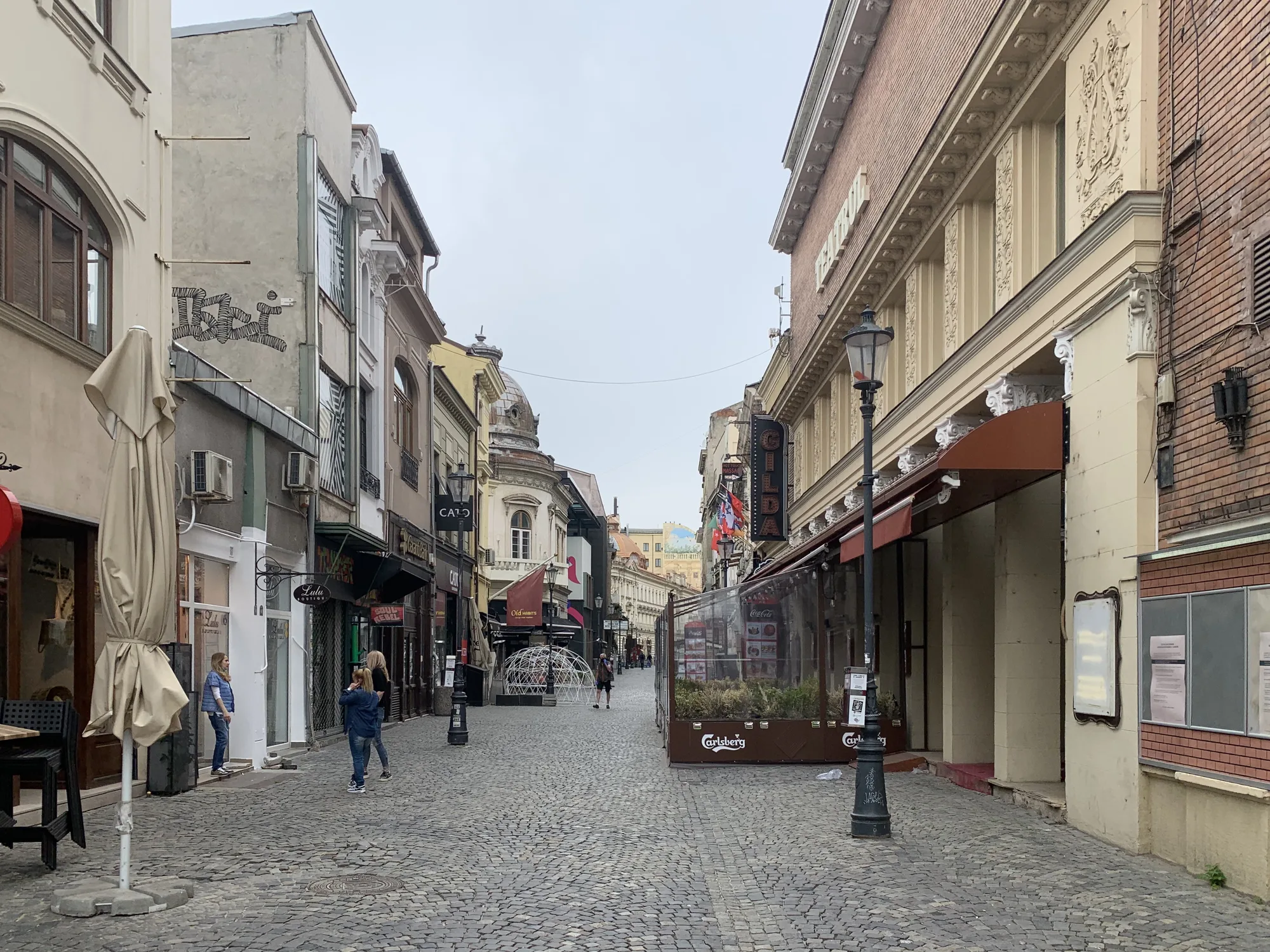
Lipscani is the spine of the Old Town, first recorded in the late 16th century as Ulița Mare ("the Great Street"); its name comes from the merchants who brought goods from the Leipzig (Lipsca) fairs. The lanes branching off it still carry their medieval guild names — Blănari (furriers), Șelari (saddle-makers), Gabroveni (after merchants from Gabrovo) and Smârdan (the former "German Street"). Let the streets guide the walk; the reward is small details — carved doorways, courtyards and passageways — rather than ticking off a list.
Timing tip: Keep the pace slow and look up; the best details are above street level.
~200 m on · 15–20 min
This is where Bucharest began. Curtea Veche, the Old Princely Court, is the city's oldest surviving medieval monument — the fortified residence linked to Vlad III the Impaler (Vlad Țepeș), whose 1459 document is the first surviving written mention of Bucharest. Next to the ruins stands the small Curtea Veche Church (c. 1559), the oldest church on its original site in the centre. It grounds the whole walk in the founding story of the city.
Timing tip: Even if the museum is closed, the courtyard and church exterior are worth the few minutes.
~150 m on · 15 min
A few steps from Curtea Veche is the galleried courtyard of Hanul lui Manuc, built in 1806–1808 by the Armenian merchant-diplomat Manuc Bei as a khan (caravanserai) by the Dâmbovița. Wooden balconies wrap a cobbled inner yard — it hosted talks toward the 1812 Treaty of Bucharest and is the city's oldest operating inn building. Step into the courtyard even if you are not eating; it is one of the most atmospheric corners in the Old Town.
Timing tip: It is also a strong, if touristy, lunch option later in the loop.
~400 m back into the lanes · 15 min
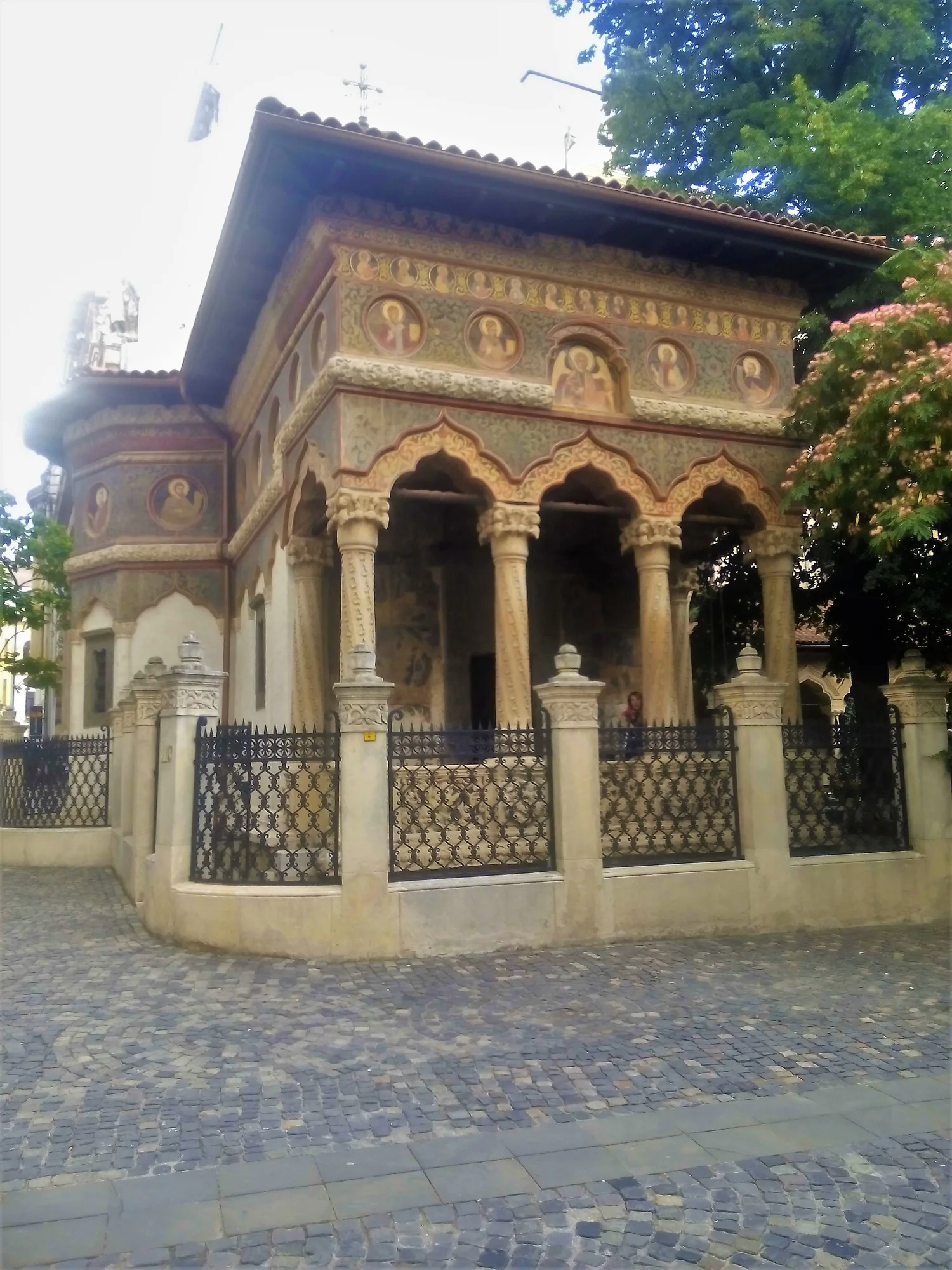
A small but atmospheric stop that breaks up the Old Town energy. The church was built in 1724, under Prince Nicholas Mavrocordat, by the Greek monk Ioannikios — a jewel of the Brâncovenesc style, with a colonnaded courtyard, frescoed interior and Romania's largest collection of Byzantine-music books. It is one of the most photogenic quiet moments in the centre.
Timing tip: Step inside briefly, then continue the loop without rushing.
~250 m on · 10 min
One of the most iconic Old Town visuals: a fork-shaped, yellow-glass-roofed covered arcade designed by architect Felix Xenopol and opened in 1891. The two-tined plan wraps around a hotel the owner refused to sell — one arm meets Calea Victoriei, the other heads toward the National Bank. The covered passage adds a "hidden city" layer to the route, and the yellow glass glows beautifully in soft light.
Timing tip: Go mid-morning for softer light and fewer crowds.
~300 m on · 20–30 min
A classic Old Town stop and an easy interior highlight at Strada Lipscani 55. The bookshop opened in 2015 inside the restored early-20th-century Chrissoveloni Palace (a former bank, then a general store) — six floors arranged around a luminous white spiral atrium, with a top-floor bistro that makes a natural reset point before lunch.
Timing tip: Pair it with a café stop to slow the pace.
Total ~2 km · 2–3 hours at a relaxed pace
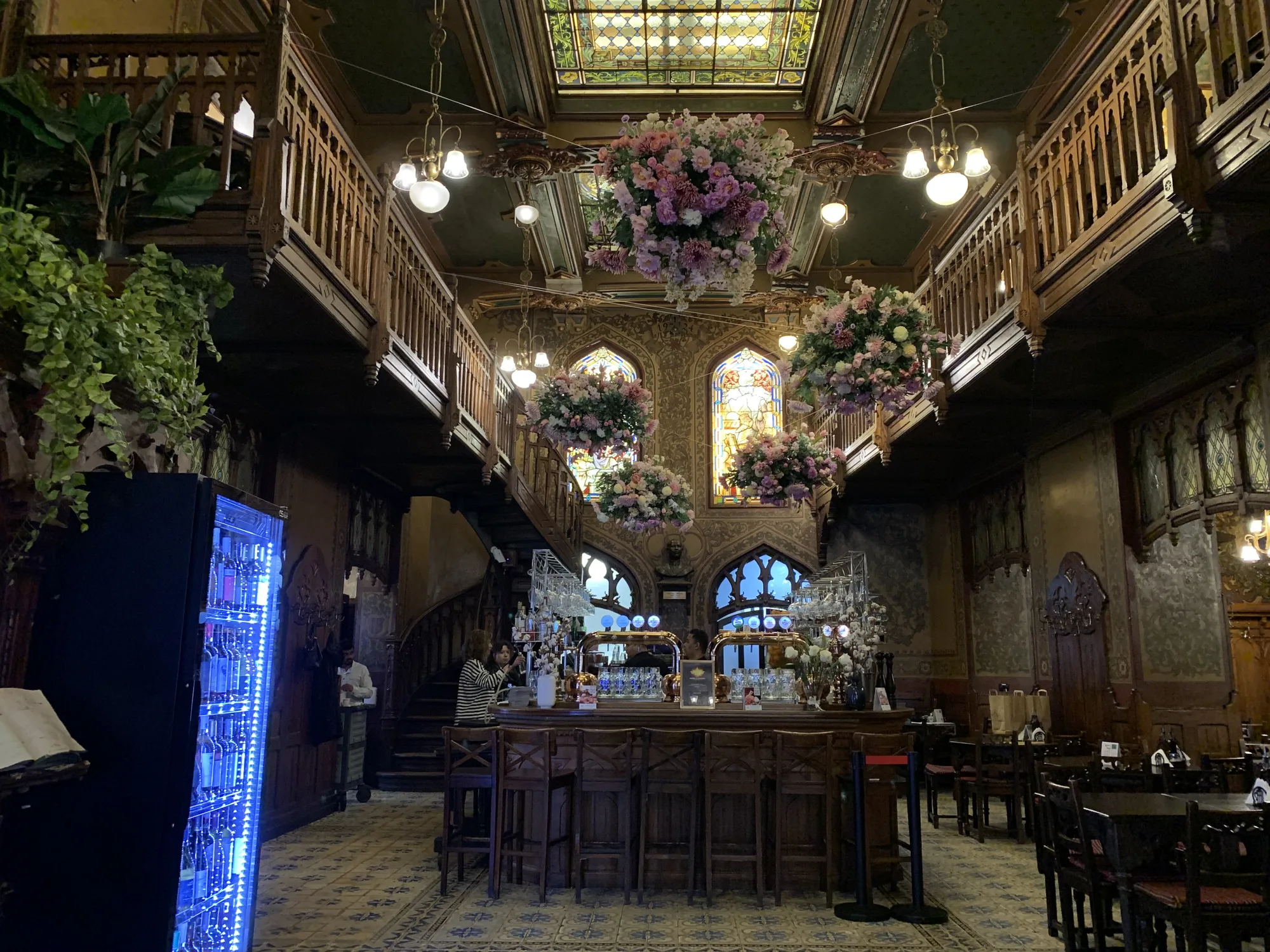
End where the energy gathers after dark. Old Town evenings are best when the plan is intentional: one standout dinner, one great bar, and a short scenic loop back past the lit passages and Lipscani lanes. The whole circuit covers roughly 2 km on cobbles, so it is easy on the legs even at a wandering pace.
Timing tip: Choose quality over quantity—Old Town is more fun when not chaotic.