Romanian Athenaeum area
The classic “Bucharest elegance” moment: architecture, culture-night energy, and a perfect photo stop.
Athenaeum tickets →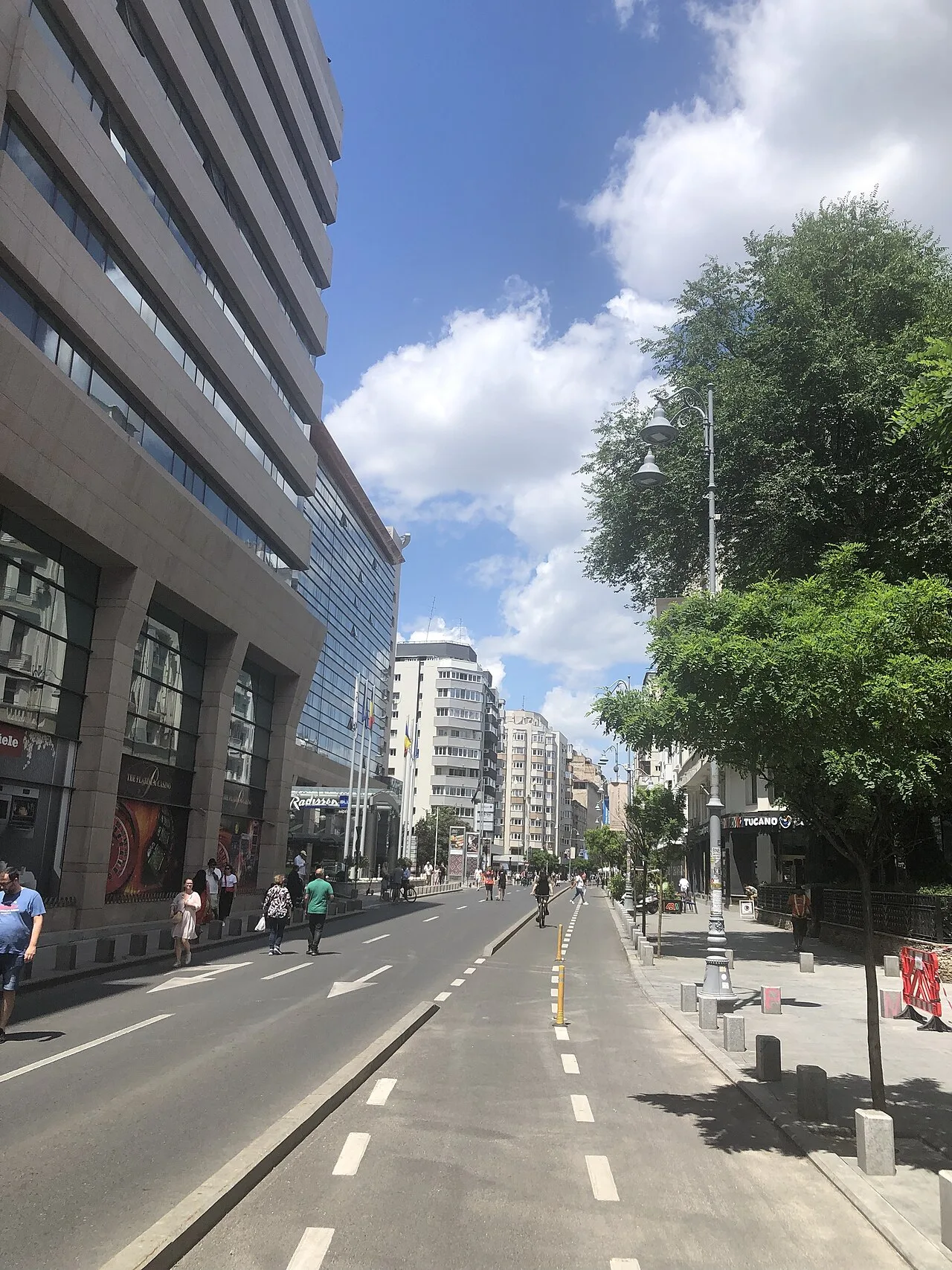
Bucharest Boulevard Guide
A self-guided walk with the best stops: culture landmarks, cafés, and golden-hour atmosphere.
Reviewed May 2026 · Love Bucharest editorial team
Photo: Turgidson · CC BY-SA 4.0 · Wikimedia Commons
Calea Victoriei is a walking street in spirit, even when cars are nearby. It is where the city shows its elegance: facades, museums, classic cafés, and the kind of evening light that turns a simple stroll into a highlight.
Calea Victoriei is Bucharest's historic spine — a roughly two-kilometre boulevard running from Piața Victoriei in the north down to Piața Națiunile Unite near the river. Laid out as the city's grand promenade, it became the stage for the late-19th-century and Belle Époque era when Bucharest, modelled by its French-educated elite on Paris, earned the nickname Micul Paris ("Little Paris"). The boulevard was its Champs-Élysées: a parade of palaces, banks, hotels, theatres and cafés where high society saw and was seen.
That heritage is why a single walk teaches the city so quickly. Within a few blocks you pass the domed Romanian Athenaeum, the former Royal Palace (now the National Museum of Art), the civic drama of Revolution Square, the Beaux-Arts CEC Palace and the Art Nouveau Cantacuzino Palace. The mix of styles — Neoclassical, French eclectic, Art Nouveau, interwar modernism and a few brutalist intrusions — is a compressed lesson in Bucharest's layered, sometimes turbulent, history.
The best way to experience it is not to march from one end to the other but to choose a few anchors and let the rhythm of the street do the rest: a museum, a concert or self-guided visit at the Athenaeum, a coffee in a heritage café, and a slow golden-hour stretch. On many summer weekends the central section is closed to traffic as "Strada deschisă," which is the loveliest time to wander.
If Bucharest has one boulevard that teaches the city’s style quickly, it is Calea Victoriei: elegant facades, cultural landmarks, and the best walking energy in the center.
A walk here connects Old Town-adjacent energy with museum districts and classic city squares.
Summer evenings, autumn golden hour, winter culture nights — the boulevard adapts to the trip.
Begin near the central squares and ease into the boulevard vibe with a coffee stop.
The heart of the boulevard’s “historic and cultural” layer. This is where you slow down and look up.
Even if there is no concert, the area is one of the most iconic photo and culture moments.
Continue if energy is high, or loop back toward Old Town for dinner. The best route is the one that matches the day.
These are the landmarks that define the boulevard. You will not see every one in a single walk — pick a couple as anchors and enjoy the façades in between.
The boulevard's signature building: a domed neoclassical concert hall designed by French architect Albert Galleron and inaugurated in 1888, partly funded by the public-subscription campaign "Dați un leu pentru Ateneu" ("Give a leu for the Athenaeum"). It is the home of the George Enescu Philharmonic, and its main hall is famed for both its acoustics and Costin Petrescu's sweeping interior fresco.
The former Royal Palace on Revolution Square now houses the National Museum of Art of Romania, with a National Gallery of Romanian art and a European Gallery holding Old Masters. It is the single best art stop on the boulevard if you want one indoor anchor for the walk.
The civic heart of the boulevard, framed by the former Royal Palace, the Athenaeum and the former Central Committee building from whose balcony Ceaușescu gave his final speech in December 1989. The Memorial of Rebirth marks the 1989 Revolution — a sombre, important stop.
An exuberant French Beaux-Arts landmark built 1897–1900 to a design by architect Paul Gottereau as the headquarters of Romania's oldest savings bank (CEC). Its glass-and-metal dome is one of the most photographed façades in the city; it faces the National Museum of Romanian History.
A flamboyant Art Nouveau palace built for the Cantacuzino family in the early 1900s, with a famous shell-shaped porte-cochère. It now houses the George Enescu National Museum, dedicated to Romania's greatest composer — a worthwhile detour for music lovers.
Just off the boulevard, the yellow-glass Macca-Vilacrosse arcade (opened 1891) is a photogenic covered passage of cafés. Nearby, the historic Casa Capșa — a café-restaurant that was the salon of Bucharest's Belle Époque elite — anchors the boulevard's "Little Paris" reputation.
The classic “Bucharest elegance” moment: architecture, culture-night energy, and a perfect photo stop.
Athenaeum tickets →Calea Victoriei pairs naturally with a museum half-day. Keep it simple: one museum, one café break.
Museum routes →This boulevard is built for coffee: short walks, long sits, then another short walk.
Best cafes →Late afternoon light makes the boulevard glow. This is the most romantic way to do the route.
Romantic ideas →Golden hour and early evening are peak for atmosphere and photos.
Pair the walk with one cultural stop (museum or concert). That is enough for a perfect day.
Autumn and spring are ideal for long walks; winter is ideal for culture-night pairings.
Look up. The best details are above street level: balconies, carvings, and old signs.
It is Bucharest's historic showcase boulevard, running roughly from Piața Victoriei down to Piața Națiunile Unite, and lined with belle-époque palaces, museums and cafés. It was the city's grand promenade in the "Little Paris" era and still strings together the Athenaeum, the National Museum of Art, Revolution Square and the CEC Palace.
The full boulevard is a couple of kilometres; walking it end to end without stopping takes around 30–40 minutes. With photo stops, a museum and a couple of cafés, it comfortably fills a half-day — the boulevard rewards a slow pace.
Most of the year it carries traffic, but on many summer weekends a central stretch is closed to cars as "Strada deschisă" ("Open Street"), turning it into a relaxed pedestrian promenade with pop-up events. If you are visiting in summer, check whether your weekend coincides.
The Romanian Athenaeum, the National Museum of Art (in the former Royal Palace), Revolution Square with the 1989 memorial, the CEC Palace, and the Cantacuzino Palace (George Enescu Museum). The yellow-glass Macca-Vilacrosse passage just off the boulevard is a lovely extra.
Yes — it offers a modest self-guided visiting ticket when the rehearsal and concert schedule allows, and far better, you can attend a George Enescu Philharmonic concert. Daytime access depends on what is on, so confirm with the Philharmonic before planning a visit around it.
Late afternoon into golden hour is the most atmospheric, when the belle-époque façades glow. Autumn and spring are ideal for long walks; winter pairs beautifully with a concert or a museum stop.
Yes — it mixes heritage cafés like Casa Capșa with boutiques and the upscale shops around the boulevard. It is one of the most enjoyable streets in the city for the classic "short walk, long coffee, short walk" rhythm.
Calea Victoriei works best when it is part of a larger plan: Old Town for history, parks for balance, and a culture night for atmosphere.
