A night-time aerial view over Bucharest, the city's radiating grid of streets brightly lit

Otopeni Transport

Airport Train to the City

When the train is the best choice, how it works in practice, and easy connections for the rest of the trip.

Reviewed June 2026 · Love Bucharest editorial team

Photo: George M. Groutas · CC BY 2.0 · Wikimedia Commons

The round neoclassical Romanian Athenaeum concert hall in Bucharest, with its domed roof and Ionic-columned portico
The Romanian Athenaeum, the gilded Belle-Époque concert hall at the heart of the city.Photo: Diego Delso · CC BY-SA 4.0 · Wikimedia Commons

The airport train is about avoiding stress, not chasing perfection

The best airport transfer is the one that matches the moment: traffic, luggage, arrival time, and destination neighborhood. Use the train when it removes friction—especially during busy road periods or when connecting onward.

Best when traffic is heavy

If the roads are congested, the train can be the calmest way to reach the city without watching the meter tick in traffic.

Best for connecting onward

If the next step is another train or metro connection, arriving near major transit hubs can be very convenient.

Not always the simplest for Old Town

If the destination is deep in Old Town with luggage, a direct taxi/rideshare can still be the easiest choice.

🚆

How to use the airport train (simple steps)

Step 1: Find the airport rail station

The line connects Henri Coandă Airport (Aeroport Henri Coandă) with București Nord — Gara de Nord, Bucharest's main railway station. From arrivals, follow the rail signage to the airport station; because the airport is being renovated, the walking path and platform access can shift, so trust the current signs over any older map. Allow a few extra minutes to get from the terminal to the platform.

Step 2: Buy a ticket before you board

A single fare runs about 6 lei (roughly 6.5 lei; children pay around 3 lei). Buy it at the CFR kiosk in International Arrivals or at the platform ticket machine — buying from the conductor on board usually adds a surcharge, so get the ticket first. Two operators (CFR Călători and Transferoviar) run the route, and a normal single ticket is valid for the next departure either way. Keep the ticket on you for the ride.

Step 3: Ride to Gara de Nord, then connect

The trip takes about 22–25 minutes. Gara de Nord sits on metro line M1 (and is a short hop from the M2 north–south line via one change), so from the station you can take the metro to Universitate or Piața Unirii for the Old Town, grab a Bolt/Uber, or walk if your base is close. Trains run roughly every 40 minutes, so check the next departure before you settle into the queue.

Note: schedules, station layouts, and ticketing options can change. For time-sensitive travel, check the current timetable and station information before arriving.

Easy onward connections

Heading to Old Town (Lipscani)

Old Town is walkable once nearby, but the final approach is easiest with light luggage. If arriving with bags, a short taxi/rideshare from the city station can be the smoothest final step.

Old Town transfer guide

Need metro strategy?

Use metro for longer jumps and walking for the center. A simple metro plan makes the trip feel effortless.

Metro guide

Prefer door-to-door?

Taxi and rideshare are often the simplest choice for late arrivals, tight schedules, or large luggage.

Taxi & rideshare guide

Train vs. express bus 100

These are the two cheap public ways into the city, and they suit different arrivals. The train is faster and traffic-proof but infrequent and arrives at Gara de Nord; bus 100 is slower in traffic but runs all day and night and drops you straight in the Old Town. Here is how to choose.

Take the train if…

  • Roads are jammed — the train ignores traffic and arrives on a fixed timetable.
  • Your base is near Gara de Nord or an M1 metro station, or you are connecting to an onward train.
  • You want the calmest, most predictable arrival without watching a meter.

Take express bus 100 instead if…

  • You are heading straight for the Old Town / Piața Unirii — bus 100 runs there directly for about 3 lei.
  • You arrive at an awkward hour: bus 100 runs day and night, while the train comes only ~every 40 minutes.
  • You would rather avoid the train-then-metro transfer with luggage.

Frequently asked questions

How much is the Bucharest airport train?

A single fare is roughly 6 lei (about 6.5 lei), with children around 3 lei. Buy it at the CFR kiosk in International Arrivals or the platform machine — paying the conductor on board usually adds a surcharge. Fares change, so treat this as a guide and check CFR before you travel.

How long does the airport train take to the city?

The ride from Henri Coandă Airport to Gara de Nord is about 22–25 minutes. Add a few minutes to walk from the terminal to the platform and, at the city end, time to connect onward by metro, taxi or on foot.

How often does the airport train run?

Roughly every 40 minutes in each direction, which is the train's main drawback. If your arrival just misses a departure, express bus 100 — which runs much more frequently and 24/7 — is often the faster real-world choice.

Where does the airport train arrive?

At București Nord (Gara de Nord), Bucharest's main railway station, on the western side of the centre. It is on metro line M1 and a short connection from the M2 line, so it is well placed for onward travel across the city.

Is the train or bus 100 better from the airport?

For the Old Town and central squares, express bus 100 is usually simpler and cheaper (about 3 lei, direct to Piața Unirii, running day and night). The train wins when traffic is heavy, when you are near Gara de Nord, or when you are connecting to another train. Neither is expensive compared with a taxi.

Can I buy a train ticket with a card?

The platform machines and the CFR kiosk handle the sale; card acceptance can vary by machine, so it is worth keeping a little cash (lei) as a backup. Buy before boarding to avoid the onboard surcharge.

Is the airport train good with heavy luggage?

It is fine for a couple of bags, but you do walk to the platform and then change to the metro or a taxi at Gara de Nord. If you are arriving late, tired, or with a lot of luggage and heading deep into the Old Town, a door-to-door Bolt/Uber or an official taxi can be the easier choice.

Arriving for a short trip?

For weekend trips, keep the first day light. A smooth airport transfer plus one scenic walking loop is often better than stacking attractions immediately.


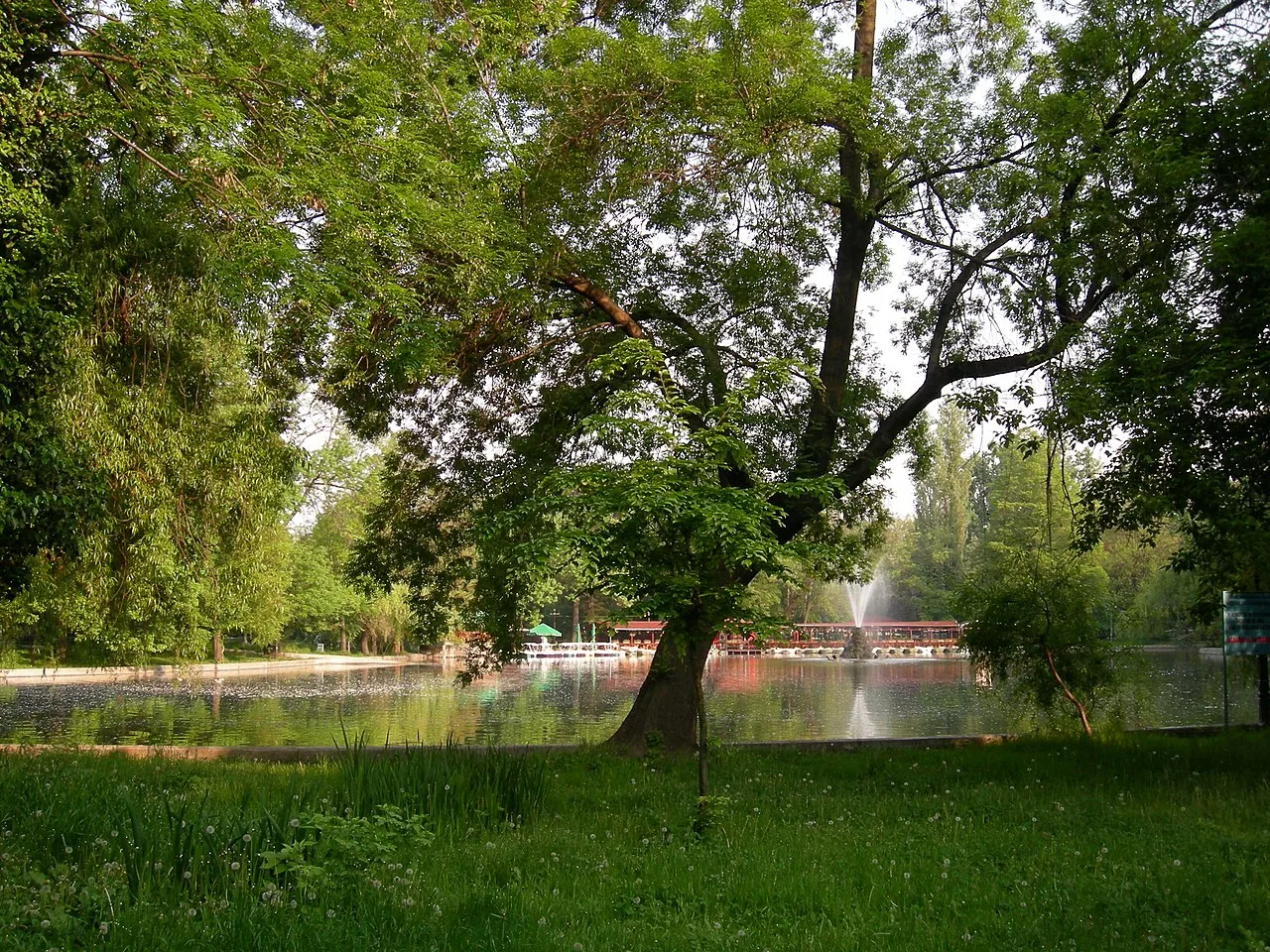
The lake of Cișmigiu Gardens in central Bucharest, with a fountain and lakeside pavilion framed by tall trees
Cișmigiu Gardens, the city's oldest public park, in the centre.Photo: Joe Mabel · CC BY-SA 3.0 · Wikimedia Commons